Range Management in North East British Columbia

Range Management in North East British Columbia

Wednesday, April 13, 2011

Society for Range Management - Montana 2011

Stillwater got blasted with the worst winter storm in recent history. This is a picture looking out my dorm room to the snow drifting high outside and on my window sill. Thank goodness for space heaters from WalMart to keep me warm in my room along with many quilts and fleece pants! School was closed for a week. Temperatures dropped to below -30C. And we left to head up north to Montana in the middle of all of it ...

A small herd of us decided it was best to drive to Montana for the 2011 Society for Range Management international meeting. It was a 21 hour drive north and a 21 hour drive back south ... with minimal stops along the way. I was looking forward to the trip so that I could see Kansas, Nebraska, Colorado, Wyoming and Montana but things didn't end out as hoped for. We travelled through the night, leaving Stillwater at midnight and arriving in Billings, Montana at 9pm the following evening. We had 3 white outs, major winds and storms, icey road conditions and a whole lot of car sickness from the Canadian in the back of the bus. It was good to get to finally arrive in Billings!

Castle Rock, Wyoming

Welcome to Wyoming!

Wyoming!

Winter storm on the way in Wyoming

Big spaces in Wyoming!


Friday, March 4, 2011

Theatre and biodiversity


Billy Elliott is the most amazing musical I have ever been to. It is an international hit and it has the potential to inspire millions to reach for their dreams even in times of adversity. Futhermore, the creators of this theatrical phenomenon and its film that was released a few years ago, are true inspirations. In particular, I make reference to Eric Fellner who is a smart businessman and an entrepreneur and who is diverse in his creativity from producing films to television shows to documentaries and now to theatrical performances.

Biodiversity or biological diversity or differences in species compositions and richness are topics that I discuss on a daily basis. Recently I completed my first exam for biogeochemistry and global change. Dr. Gail Wilson asked us to defend climate change and provide examples of global change and why it is important for the public to be knowledgeable in that subject matter. As I wrote my response, I was struck with the last sentence in one of my paragraphs which was finished off as "a decrease in biodiversity is inappropriate for the future of the earth." I was left wondering how to explain to someone else what the next logical question to my response would be : why is biodiversity important? To me, as a scientist, land manager, ranch kid, outdoor enthusiast and landscape ecologist - biodiversity is what life hinges on - it's innate that it is important!

How do I explain the importance of biodiversity to a stoke broker who lives inside a concrete building and trades foreign commodities for numbers on a computer screen? Or what about to the grade 6 class at a local elementary school that I had the good fortune of giving a 1 hour long presentation to about northern Canada last month? Or what about to the beaureacratics who do not think that humans are part of the ecosystem, who think that doing nothing is a good management decision and who sit with my papers on their desks for months on end while being the final signature in order to keep fire on the land? How do I express in words how critical heterogeneity is to the future of the boreal forest - of all global ecosystems along with keeping their natural processes "functioning properly" and the system "resilient"?

How do I explain to Eric Fellner, a very smart and admirable and respected man about the need to ensure that Wood bison survive and that their critical habitat must be maintained in order for their reintroduction to be successful?

It really hit me hard yesterday as I was preparing for our weekly paper discussion group lead by Andy Crosby (MS canddiate at OSU) and Torre Hovick (PhD candidate at OSU). We read a paper by John Wiens about conservation not being black or white but rather a portrait and mosaic of tones and hues. Just like my thoughts (and that of other knowledgeable people) of the boreal as a mosaic and patchwork of different species growing in different places, at different heights, of different ages with fire, landslides, avalanches, herbivory, insect outbreaks all occurring together in chaotic succession. Just like Eric Fellner is a diverse producer of theatrical productions. Just like a person in the stockmarket would most likely not have all their eggs in one basket but rather spread out across different stocks. Just like the oil and gas companies frac more then one well at a time ... it's about production, economics, diversifying ... finacial diversity, artistic and creative diversity, biological diversity.

So in my pitiful explanation to my uncle, Eric Fellner, I tried to explain about how important fire is in maintaining habitat for Wood bison and how it is part of natural environment. That if we remove fire, we remove part of the chaotic succession that naturally has been occurring either through wildfire or the humans that ARE part of the ecosystem. To think that humans are not part of the ecosystem is a null, rejectable hypothesis that doesn't even warrant the time it took to write this sentence. Micro-management would suggest that at minute scales, humans are not part of the tippy top of the pass that goes from the Tuchodi down into the Gataga. Landscape ecologists and those who understand that scale is important spatially and temporally would suggest that as we look around the geographical area of the Tuchodi and the Gataga, humans have been in that system for many years. So why discount our impact - our influence - our dramatic part in the ecosystem?

Eric, you have inspired me even futher into the world of diversity. My world would be biological diversity and I will be forever very proud and in awe of your world of artistic and creative theatrical diversity.

Family.

Thursday, January 27, 2011

A tribute to Ray Coupe

Ray Coupe : A man of adventure, leadership, land ethic and dedication.

After 36 years with the Forest Service, January 31st 2011 will be Ray Coupe's last day as a full-time BC Government employee. I am thankful to have crossed paths with Ray a couple years ago on the top of Nonda Mountain in the heart of the Northern Rockies. Since that time, Ray has contributed a huge amount to my learning of ecology, plants and ecosystem dynamics. I find it hard to believe that the Government could possibly think that it would be the right decision to make his position "redundant" as I am sure there are many across BC who will echo my words when I say that what Ray brings not only to what used to be called the Forest Service, but also to all Natural Resource managers and even more so to the scientific community, public and land stewards of British Columbia, is impossible to quantify.

Ray Coupe's vast knowledge is a vital asset to all of us across the entire province of British Columbia. Redundant would be the very last word on a 100 paged list that I would use to describe the critical role that Ray has played in what used to be called the Forest Service. One person's loss is another person's gain and it is my great honour, pleasure and delight to have Ray as a member of our Range and Fire Ecology Research Team in North East British Columbia. His expertise, wisdom, professionalism and dedication to helping and mentoring others is beyond any call to duty that we have as public servants. I am in awe of your selfless, generous and kind donations of your time to the Forest Service and to me and I know both of those will continue long into the future! Thank you for all you do!! Ray Coupe - you're one heck of a guy and I'm glad you're on my team! See you in the North Country this summer ( I hope $$) and I solemnly promise this to you: no more daubenmaire frames!!!! Onwards and upwards my friend! Here's to you!

Ray Coupe : The Botanist.

Ray Coupe : The Nevis Creek dancer.

Ray Coupe : The knower of all plants!

Monkshood

Ray Coupe : The Daubenmaire demon!

Ray Coupe : An intelligent and skilled team member!

Ray Coupe : The Chef!

Ray Coupe : A thoughtful contributor.

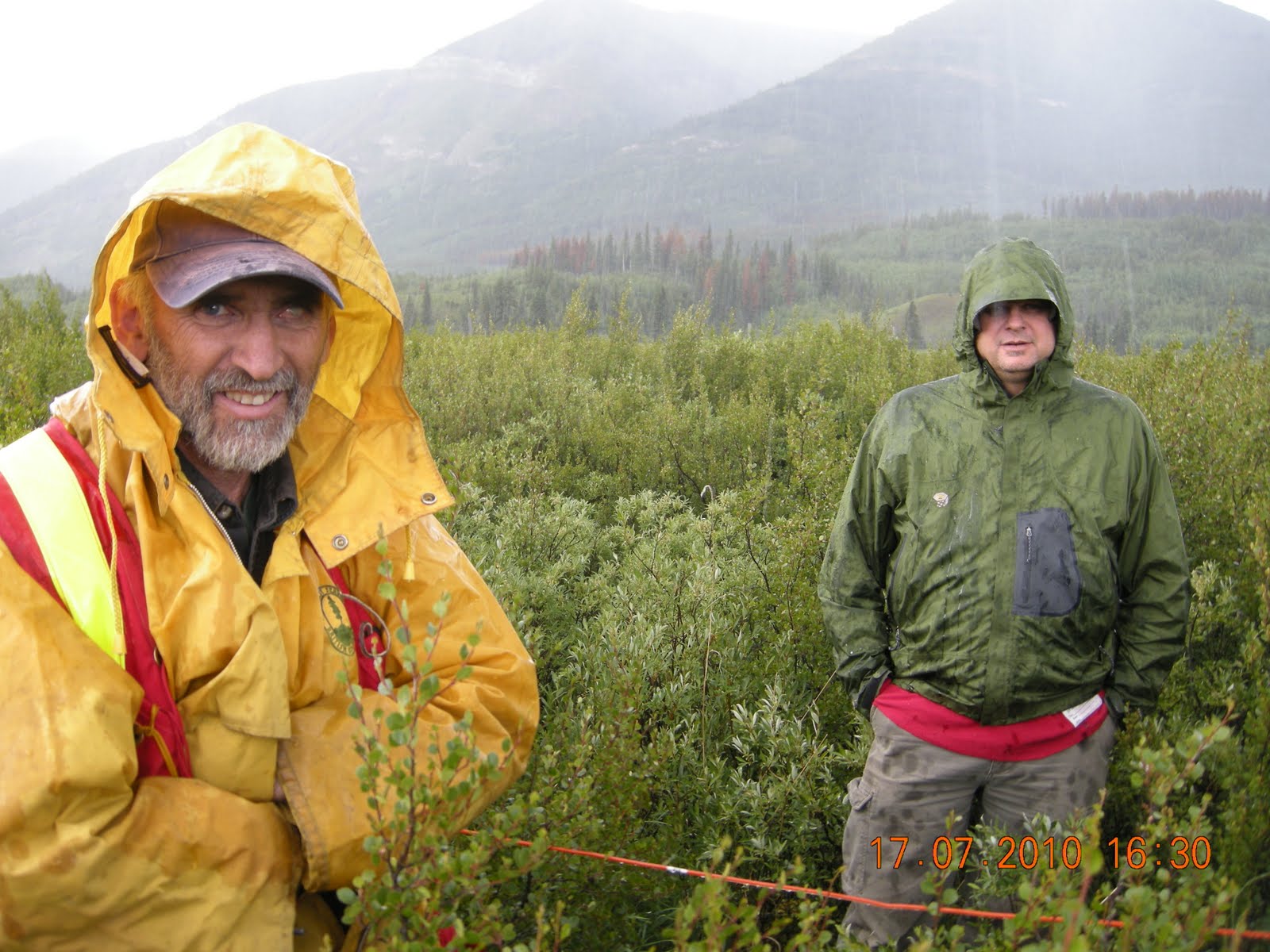
Ray Coupe : A man who maintains his cool, especially when exploring permafrost!

Ray Coupe : Weather proof.

Ray Coupe : Always calm and ready for a challenge!

Ray Coupe : A mentor and a guide.

Ray Coupe : The legend continues!

Geranium richardsonii

http://www.books-by-isbn.com/1-55105/1551050579-Plants-of-southern-interior-British-Columbia-1-55105-057-9.html

http://www.books-by-isbn.com/1-55105/1551052199-Plants-of-southern-interior-British-Columbia-and-the-inland-northwest-1-55105-219-9.html

http://www.for.gov.bc.ca/hfd/pubs/docs/lmh/Lmh46.pdf

http://www.alibris.com/booksearch.detail?invid=10513716044&browse=1&qwork=5162456&qsort=&page=1

http://www.geog.ubc.ca/biodiversity/eflora/E-FloraTreesofBritishColumbia.html

Sunday, January 23, 2011

Fire is bad because it causes ecosystem dysfunction?

2 years post fire.

In the beginning of the fall, my research assistants and I hit the exclosures on the Liard to take our 2nd year vegetation samples after Fire 084. We were amazed like many others who have studied the vegetation response in the Boreal after fire. Fire 084 burned through the summer of 2009 and grew to 24,000 ha causing an incredible mosaic of landscape throughout its run. It was actioned along the highway but allowed to run out north away from the major transportation corridor that ties the north to the south.

As you peruse the following pictures, I challenge you to ask yourself some questions:

Why not burn? Is it ecologically sound to write impact assessments on "why an area should burn" when fire has been part of that site's ecological history and evolution?

Geared up and heading into the burn to set up the plots inside the exclosures constructed in partnership with Liard River Adventures, the Wildfire Management Branch (NIFAC crews), Oklahoma State University and the Range program of the Ministry of Forests and Range.

Exclosure 1 on the north side of the Liard River, 3 months post fire in 2009.

How much proof is needed to show that fire is the dominant ecosystem driver in the boreal?

Are humans part of the ecosystem?

What happens to those species who depend on fire, when there is no fire?

3 months postfire in 2009 - clearly this landscape has been devestated by fire and this plot is a good example of how fire can cause ED - ecosystem dysfunction.

What does ecologically sound mean anyways? Function ... functionality ... proper use ... uniform distribution ...

And furthermore, why do we not talk about ecosystem dysfunction or what I will now term as the ecological ED whereby there is an inability to develop or maintain an ecosystem including the proper functioning of all natural processes for satisfactory ecosystem performance?

Tell me what you think ... sonja.leverkus@okstate.edu

Trevor Scott setting up the plots and spacing inside the exclosures.

Don Gayton and Ray Couple at exclosure 1 (same as previously shown in 2009) on the north side of the Liard River in 2010 amongst a carpet of Pink corydalis, Dragonhead mint, Bicknell's geranium, moss, grasses and other forbs ... is this system functioning?

Dr. Marten Geertsema and Ray Coupe at the aspen exclosure in Summer 2010. Is fire bad?

The aspen exclosure site 1 year post fire.

Using the 1m2 plots inside and outside the exclosure to compare the plant communities in burned and grazed vs burned and ungrazed.

Some dysfunctional Hairy Wild Rye to the left of Michelle? Max heights for 1 year post fire were up to 160cm ... clearly another case of ED (ecoystem dysfunction)? I would disagree...

Michelle Edwards (formerly of BC Timber Sales) with Dave (as bear watch) from the Hotsprings. Excellent field crew!


Year 2 of Exclosure sampling. Michelle Edwards (formerly of BC Timber Sales) and my mum Dr. Gillian Leverkus and I at the end of sampling. A tip of the hat to Ranger Al for covering bear watch duties for a day in Fall 2010. I owe a big thank you and special recognition to my field crew: Trevor Scott, Gillian Leverkus and Michelle Edwards.

Me 'n Woody the Wood bison. Woody watched over us while we were doing our vegetation work.

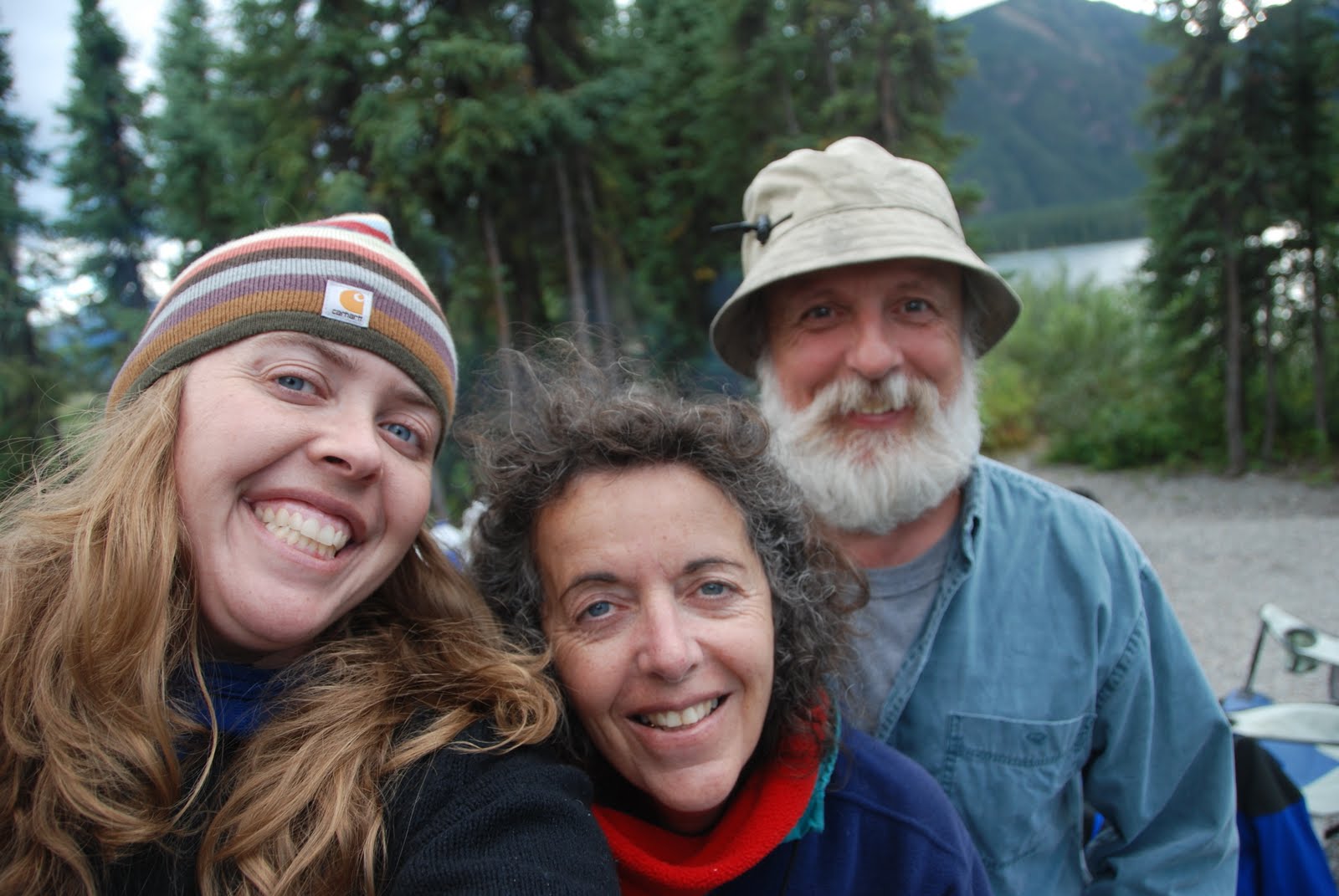
The 2009 field crew: Gillian Leverkus, Trevor Scott and I - the definition of hard work, outdoor enjoyment and family. Thank you mum and Trevor for believing in me and for all your sweat, blood, guts and tears with me!!!! I am proud to be family with you!
Saturday, January 15, 2011

The elusive Wood bison

Charles Dickie, Dr. Helen Schwantje, Wood bison cow, Sonja with Ranger Al protecting us in the background.

It's always true that when you are looking for something that is typically found in a specific location, it's not going to be there that day. Such is true with the Wood bison herds of the Fontas and Liard. This past November brought us a week of working with the bison. The plan was to tranquilize the cows with collars, download the data from the past year and a half, put new batteries in those collars and add 2 more new GPS pods to make our sample size increased to 7 animals per herd and then I was to start analyzing the data for the Society for Range Management conference in Billings, Montana in February 2011 and to further analyze that data for my thesis and for the Ministry of Environment and Habitat Conservation Trust Foundation.

But! Such was not the way it came to an end! Only one collar was retrived from the Fontas (Etthithun herd), however, four collars were retrieved from the Liard (Nordquist herd). Although we had 5 collars in our hands, we were only able to download the data from 4 of the collars (one from Fontas and the rest from Liard). It would appear that the wires at the base of the collars were snapped/torn.

Some pictures from our intense, emotional roller coaster ride of a time doing the bison work include ....

Dr. Helen Schwantje teaching Charles Dickie about the tranquilizers used on the Wood bison.

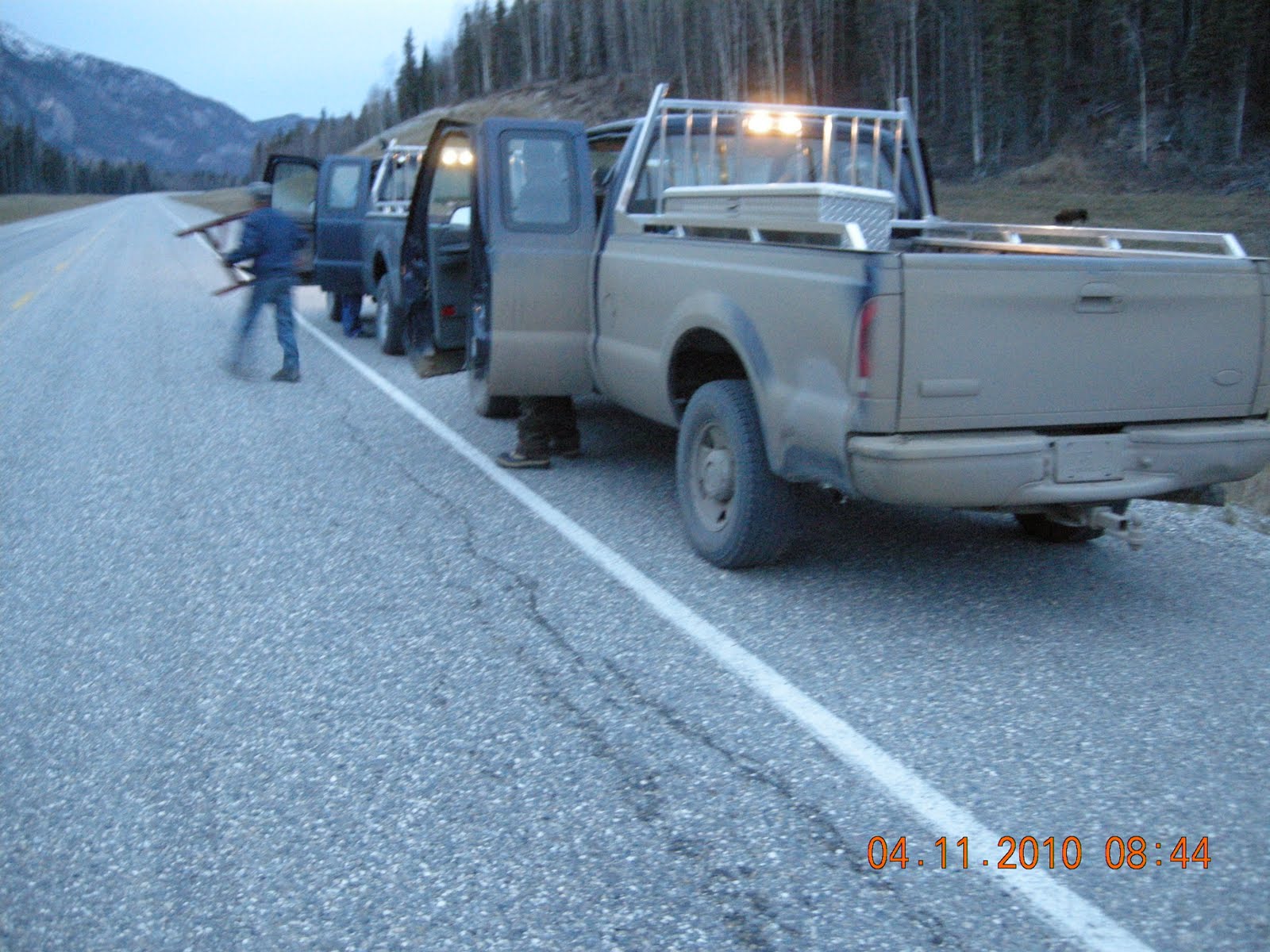
The crew getting set up on the Alaska Highway with a Wood bison herd less then 20 feet away.

All great stories start out with ... it was a cool, calm morning and the Bison were all grazing peacefully by the side of the Alaska Highway... this herd ended up spooking and stampeding across the highway, not to be found until later in the day. Onto the other herd ...
Conservation Officer Jeff Scott and Wood bison cow.

Tyler Mattheis and Charles Dickie with one of the matriarchs (tranquilized)

Conservation Officer Jeff Scott helping Conrad Thiessen (Wildlife Biologist) and Helen work on the matriarch.

Conrad, Ranger Al and Tyler processing the matriarch.

Conrad Thiessen and I with a matriarch.

All a person could ever hope for is to have two big, strong bulls trying to lift you up to bring you back to the herd should you go down.

Charles Dickie and I putting the new GPS pod collar on.

Conrad won the sharpshooter of the day award for his excellent accuracy with the tranquilizer gun.

Charles Dickie monitoring the Bison herd the day after working with them.

The one who got away! She escaped us and we were unable to recover the collar. In a couple weeks, it should blow off and hopefully Ranger Al and Conrad will go up and retrieve it!

The Crew: Ranger Al Hansen, Dr. Helen Schwantje, Tyler Mattheis (NRRM), Charles Dickie, Sonja, Conrad Thiessen and Wood bison cow (missing: Armand and Conservation Officer Jeff Scott. Photo credit: Armand)